
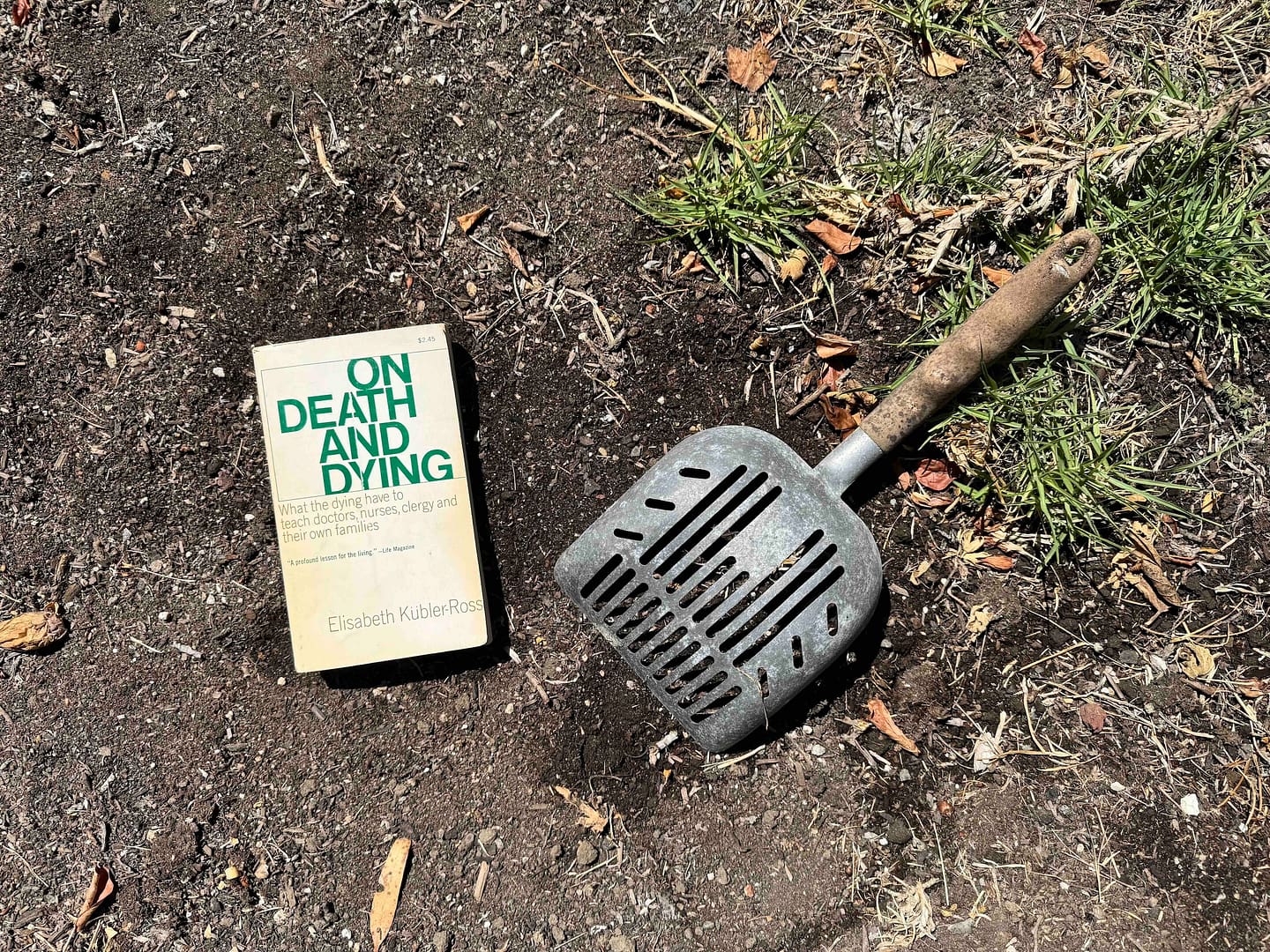
Walking in downtown Santa Cruz, I made a stop at the bookstore “Bookshop Santa Cruz“ for a quick browse. I wasn’t looking for anything specific. I stepped in, walked past the front desk, made a left, and started randomly checking out a mid size cart containing used non-fiction books. At first sight, my eyes were fixed on this book “On Death And Dying”. I always wonder about death; however, I have never found someone who is capable of examining this topic and its surroundings in depth with me.
The very few times I’ve talked to someone about death and dying have been to scratch only the surface at the very top layer, before the participant started to switch to light jokes to change the topic. Most of the time, I’ve encountered that people don’t want to talk about it. So what I found in this book is an open window to the heart of some individuals who were confronted with death, either directly or indirectly, by a beloved one.
On Death And Dying
This book, written by Dr. Elisabeth Kubler-Ross, is an essay and a practical research to improve the quality of care of terminally ill individuals as well as educating their closest family (either blood relatives or not) Elisabeth, via interviewing hospital personnel, patients, and relatives, exposes a great complexity of this scenario at an emotional level which otherwise I wouldn’t have known personally, not even if it were me at some point being either a relative or the person themselves in such stage of life.
“Watching a peaceful death of a human being reminds us of a falling star; one of a million lights in a vast sky that flares up for a brief moment only to disappear into the endless night forever.”
Dr. Elisabeth Kubler-Ross
Confronting Our Own Mortality
Thinking about death is a natural human thing to do. From our early childhood stage, when we start developing a sense of our surroundings, we begin to learn that living organisms are not immortal. We gradually grasp the idea of what death means, to the point that we might have even cried, “Am I going to die?” If we were feeling some sort of pain or discomfort. It is understandable. We have seen in one way or another, like in TV shows and movies, that those are the feelings manifested most of the time when someone passed away.
Fast forward, we have grown up. Maybe you are in your 20s, or maybe you are older, in your 40s (I will be there in a year), or maybe you are an experienced person in your 60s. In any case, we have developed a more complex understanding of that matter. We have also learned how to use death in an abstract form of expression, and sometimes (or many times) we experienced death without dying. A loss of your significant other’s love.
Who hasn’t wondered at some point what passing away would feel like? Maybe it is like when we go to bed and fall asleep. A sudden disconnect from our awareness and consciousness.
The Five Stages of Grief
Now, what’s interesting about this book is the subjects who are people in a terminally ill condition, and from whom Dr. Elisabeth Kubler-Ross observed and introduced the five stages of grief: Denial, Anger, Bargaining, Depression, and Acceptance. Those are the emotions that we all know and learned about grief, but there is an important detail that Dr. Elisabeth Kubler-Ross points out. Those emotions don’t occur in a linear timeline manner; instead, they can be experienced in any order at any time and can be felt more than one time at different times.
People who were interviewed by Dr. E. Kubler-Ross would show themselves as being at one of the five grief stages, and alternating between them without any specific order. Open to share their feelings, expressing what worries them, and what things they want to do before dying. How they want to be treated. Some of them feel guilty of dying because they will be leaving a heavier load on their loved ones. Others are trying to bargain for extra time to do one last thing they always wished to do.
Understanding people’s emotions in such circumstances was a groundbreaking work to significantly improve the quality of care of terminally ill people and their loved ones. In addition, it’s a framework that can even be used in other, less tragic circumstances. For example, when breaking up with your partner, or even when we lose something or have something stolen that had personal value.
Living With Awareness
I think about this book sometimes, because one day it will be my turn to accept the end of my life, and that day could happen without any notice in advance, who knows. Therefore, that reminds me to be present and grateful for this journey that I am living each day.
Leave a Reply