
A Dollar Book, Nine Years Later
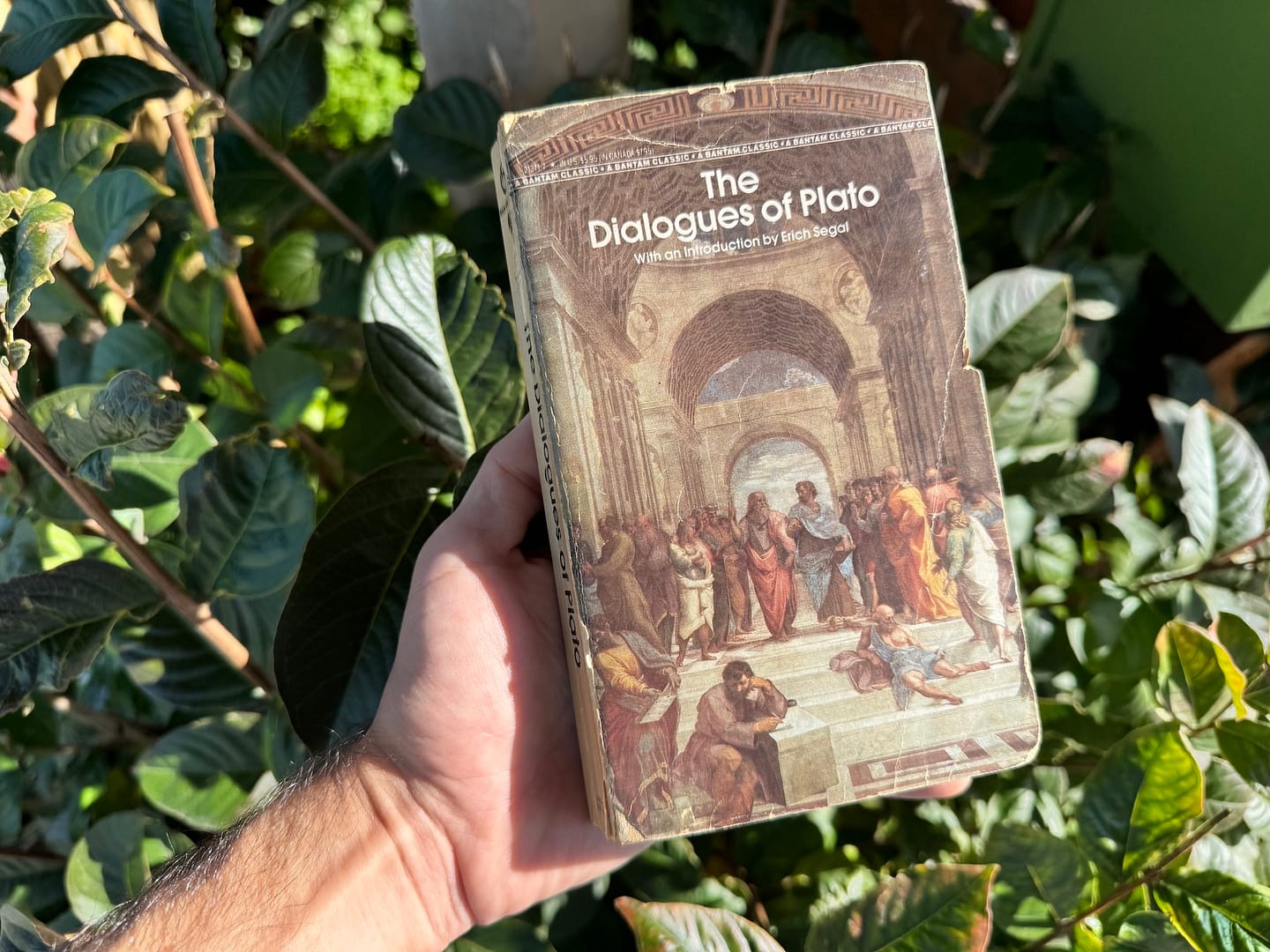
I moved to New York in November 2016. During the first month, I stayed in Brooklyn, at an apartment of an acquaintance of mine—although we weren’t close as friends. I was allowed to sleep in the living room while I was looking for a shared apartment. She brought me to her friend’s apartment, who was selling her stuff because she was moving out and wanted to declutter before packing. I grabbed a small pile of books and stumbled upon The Dialogues of Plato—I’ve always been drawn to philosophical books—so I bought it for $1. Since then, I’ve been carrying that book with me wherever I go, until I decided to start reading it in October 2025.
I’ve been curious for a long time about the Socratic method of teaching through questioning. But don’t get this wrong, when I say questioning, I don’t mean questioning a person, but questioning the true meaning of a given idea. This is critical to understand it well, otherwise, people who are unfamiliar with this method would often get offended and adopt a defensive position. Only when we can detach from our own ideals and be observant of the external world, we would be able to enjoy the Socratic method approach that will help us to get past the surface into the deeper layers of understanding.
“The unexamined life is not worth living” — Socrates
Discovered Truth vs. Told Truth
A told truth is not a truth discovered—A friend of mine once said during one of our conversations. That’s a beautiful expression that sums up entire books that have been written about personal growth. It was the first time I came across that expression, and that made me curious about who the pioneers were that portrayed that idea—It seems to be attributed to philosophies like Taoism and teachers like Osho. In essence, Socrates was the father of teaching how to make you discover the truth by yourself through questions—As opposed to telling you the truth.
How many times have you told someone the truth? Spending your energy on long conversations to prove it—Sometimes taking days, months, or years. Then one day, that person with whom you spent so much energy and effort comes back to you and says they discovered the meaning of something or that they realized a truth about something. So you are thinking—Or you say—“Well, I told you so!”—I personally wouldn’t say it out loud, and in fact, I more often avoid telling the truth unless a person asks me.
Living an Examined Life
Now, asking good questions is a form of craft/art that requires expertise and a well understanding of the context surrounding the matter that is being examined. Questions without a purpose must be avoided—They’d probably be seen as dumb questions. Paraphrasing in your own words before formulating a question helps most of the time—That also shows the other person that you are able to comprehend the matter at hand.
Although that doesn’t mean to always paraphrase, as it has the risk of getting into a redundant or too repetitive conversation. There isn’t a step-by-step guide on how to formulate questions. It’s based on experience, trials, and errors—Most importantly, how well you are able to connect with who you are having a conversation with.
“The most important question a man must ask is: In what way should one live one’s life?” — Socrates
The sooner we question ourselves about how we are living and the more often we do it to ensure we are on track—or we haven’t detoured too much—the better. Now that I’m a year away from turning 40, I can see why people go through a midlife crisis. Suddenly, you realize that you’ve put too much time and effort into something that wasn’t meaningful to you. You chased someone else’s dream. However, it’s never too late to turn the wheel and change course. There will be internal emotional challenges—Trust the process, it’s part of your personal growth.
Take a moment to think about this. What’s important to you? What are you passionate about?—Perhaps you haven’t discovered your passion yet, and that’s ok. I’ve met people who knew from an early stage of their life what they wanted to pursue, and also people whose pursuits have changed over time. That’s all great.
What I believe matters is to choose your life’s path that resonates the most with your values and makes you feel content—As opposed to following someone else’s life choices just because you have been told or forced to. There will be things that will need to be let go—could be your hometown, living close to your family, friends, traveling, hobbies, so on and so forth…and some of those decisions will hit harder than others. Life will continue its way forward.
The Irony of Written Wisdom
There are other topics that this book touches heavily on—justice, the just vs. the unjust, virtue, and soul. The examination by Socrates of those themes through questions and conversations with other philosophers is mind-awakening. Thankfully, Plato captured Socrates’ words into written text—Socrates didn’t like to write down his thoughts as he strongly believed in the evolution of knowledge over time through active dialogues, which would make any written text obsolete.
So for him, someone relying on old written books would be a fool. Well…I’d be a fool then! What an irony…his ideas wouldn’t have survived otherwise if it weren’t for the writings of his students. But who’s to say Socrates wouldn’t have eventually come around to appreciating written texts? Perhaps he just needed a few more centuries to reconsider.
Leave a Reply